The transition from legacy SETA qualifications to QCTO occupational qualifications has raised concerns among learners and clients.
While change can be daunting, the good news is that the core of the QCTO qualifications offered at Maccauvlei remains the same. The shift is not about making things harder but about improving standardisation and ensuring qualifications are truly aligned with workplace requirements.
To clear up misconceptions and ease concerns, we spoke to Noreen MacPherson, Maccauvlei’s Learning and Development Specialist. She explained why this change is beneficial and why learners at Maccauvlei can be confident about their success under the new system.
Similar Knowledge, Similar Skills – Just a New Approach
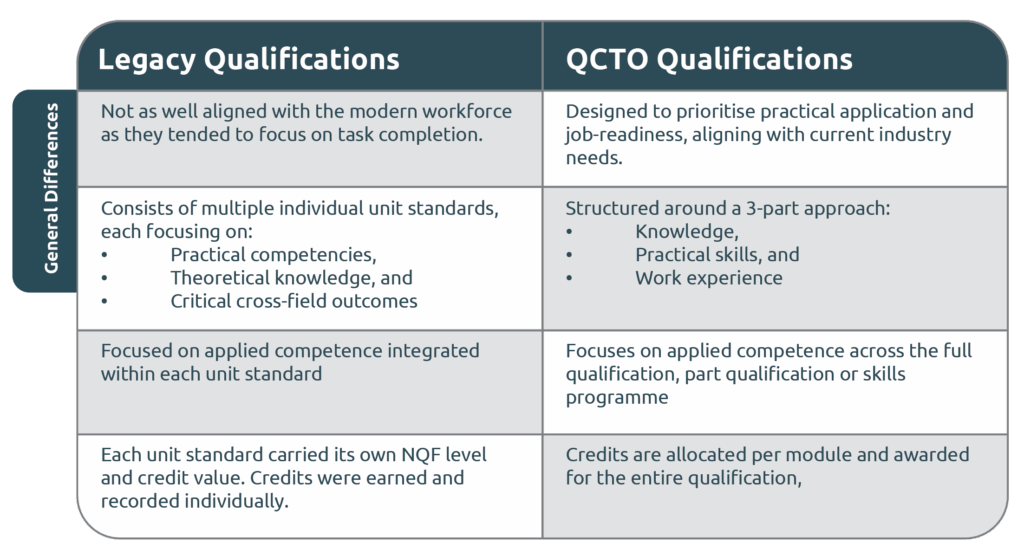
Legacy qualifications were designed in a unit-standard format, which covered theoretical knowledge, practical skills, and workplace application in an integrated manner. These qualifications, while comprehensive, were quite generic. The QCTO framework has refined this approach by structuring qualifications around specific occupations.
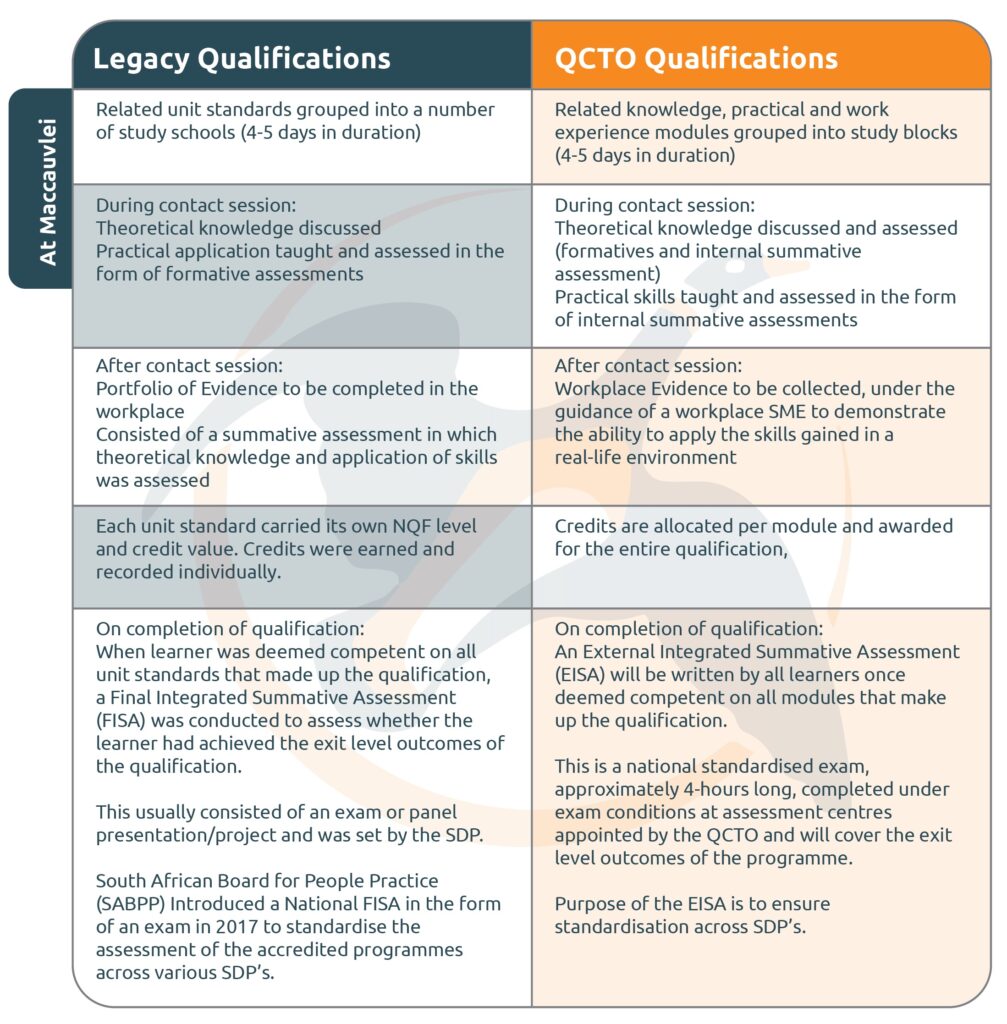
In the new set-up, theoretical knowledge, practical skills and work experience is differentiated into distinct modules, instead of being integrated into the various unit standards.
“Previously, qualifications such as Occupationally Directed Education, Training, and Development Practitioner (ODETDP) were structured like stepping stones from Level 4 to Level 5 and so on. The new QCTO qualifications still follow a similar progression but with a stronger occupational focus,” explains MacPherson.
This ensures that learners graduate with skills that are directly applicable to their chosen careers.
The Key Differences: Why the External Exam?
One of the biggest changes with Occupational qualifications is that learners must now complete a national external exam on completion of all modules. This shift ensures standardisation across all Skills Development Providers (SDPs), addressing inconsistencies in teaching quality.
The South African Board for People Practices introduced standardised examinations in 2017.
“I have been in the fortunate position, as a national examiner since 2017, to witness the impact of the lack of standardisation and just how different providers fare. Some SDP’s have had very high failure rates – as high as 80%,” she says.
“At Maccauvlei, our pass rates are consistently around 90%. This proves that our quality of teaching prepares learners well, and they don’t need to fear the exam.”
How Maccauvlei Supports Learners
Learners and clients may be concerned that the new system makes qualifications more difficult. However, MacPherson asserts that:
- The learning experience remains largely the same. Learners will still receive theoretical instruction in the classroom and apply practical skills under guided conditions. Theoretical knowledge and practical skills will now be assessed during and after the contact sessions, which actually makes the process simpler for learners.
- Work experience is still an essential part of the qualification but is assessed separately and verified by a workplace subject matter expert.
- Preparation for the national exam will be thorough. Maccauvlei has a proven track record of success, and learners will receive all the necessary support to excel.
Why This Change is a Good Thing
While adapting to the QCTO system may seem challenging, it ultimately benefits both learners and employers. The new framework ensures that qualifications are better aligned with job roles, making graduates more employable. The national exam guarantees consistency, so that a qualification earned at one provider holds the same value as one earned at another.
“We are telling our learners: If you trusted Maccauvlei before, you can trust us now,” says MacPherson. “You will still walk away with the same high level of knowledge, skills, and competence – just with a stronger occupational focus and a nationally recognised assessment to prove it.”
At Maccauvlei, we are committed to making this transition as smooth as possible. We understand the concerns, and we are here to support our learners every step of the way.
If you have any questions about how the QCTO framework affects you, reach out to us – we’re happy to help!
For more detail on the differences, MacPherson has developed this helpful comparison table:
General Differences
At Maccauvlei